Thomas is the EMEA Global Black Belt (GBB) for Sovereign Cloud at Microsoft, helping organizations across the region harness Microsoft’s sovereign, hybrid, multicloud, and edge solutions. He works directly with C-level leaders and technical teams to remove roadblocks, accelerate digital transformation, and shape long-term cloud strategies that meet business and regulatory needs.
With over 15 years of experience in cloud and datacenter, including his previous role as Principal Program Manager and Chief Evangelist for Azure Hybrid, he combines deep technical expertise with a passion for customer success. He specializes in creating scalable architectures, solution accelerators, and thought leadership that drive adoption and innovation on Azure.
Thomas is a passionate community advocate and frequently speaks at industry events such as Microsoft Ignite and Microsoft TechDays. He shares his expertise through his Cloud and Datacenter Blog at www.thomasmaurer.ch and on LinkedIn and X.com www.twitter.com/thomasmaurer.
This is how you verify MD5 checksums on Windows
The Easy Way (digestIT with GUI)
digestIT is a graphical tool that should be easier to use for most Windows users.
Download digestIT.
Navigate in Windows Explorer to the directory where you saved/downloaded the OpenOffice.org archive.
Right click the OpenOffice.org archive file in and select digestIT -> Verify MD5 Hash (or Calculate MD5 Hash).
If you select “Verify MD5 Hash” then you will be able to copy and paste the MD5 from MD5Sum page (linked to on the latest download page). If the checksums match, you will see: “Digest matches. Verification succeeded.”
If you select “Calculate MD5 Hash” then you will need to visually compare the calculated MD5 with the one listed on the MD5Sum page (linked to on the latest download page).
There is also another simple application “Checksums calculator” a GUI tool to calculate md5 witch can run under Linux, Windows and MacOS x operating systems on both 32 and 64bit architectures. For more info take a look here: http://www.sinf.gr/en/hashcalc.html
I disagree with the commenters, agree with the poster. Use FCIV.
Also why download a third party tool that also runs on linux, etc when there are already integrated tools for Linux and most unix?
But i have created a md5sum in linux using native utility, transfer files for FTP and when it arrive to windows 7 i need a utility for confirm if ftp was correct, i have tried with FCIV utilitybut it dosen’t work because in linux md5sum generate a plain file with some structure and FCIV use xml so it have different structures. How compare a md5 file generated in linux with another generated in windows for verify a ftp transfer?
@ivo ochoa: not only the five uses xml instead of a plain file, but the checksum is base64 encoded too into the xml… I think it is easy to code something that let you compare the five output with the md5sum one… Probably there is already something on the net that let you do that comparison…
thanks. So from you comment, we have to use an image file (img iso …), you can’t run a command straight on a CD/DVD as this linux command :md5sum /dev/scd0 ?
My name is Thomas Maurer. I am a EMEA Global Black Belt (GBB) for Sovereign Cloud at Microsoft. I am part of Azure Cloud & AI Platforms and engage with the community and customers around the world. Opinions are my own.
We use cookies on our website to give you the most relevant experience by remembering your preferences and repeat visits. By clicking “Accept All”, you consent to the use of ALL the cookies. However, you may visit "Cookie Settings" to provide a controlled consent.
This website uses cookies to improve your experience while you navigate through the website. Out of these, the cookies that are categorized as necessary are stored on your browser as they are essential for the working of basic functionalities of the website. We also use third-party cookies that help us analyze and understand how you use this website. These cookies will be stored in your browser only with your consent. You also have the option to opt-out of these cookies. But opting out of some of these cookies may affect your browsing experience.
Necessary cookies are absolutely essential for the website to function properly. These cookies ensure basic functionalities and security features of the website, anonymously.
Cookie
Duration
Description
cookielawinfo-checkbox-analytics
11 months
This cookie is set by GDPR Cookie Consent plugin. The cookie is used to store the user consent for the cookies in the category "Analytics".
cookielawinfo-checkbox-functional
11 months
The cookie is set by GDPR cookie consent to record the user consent for the cookies in the category "Functional".
cookielawinfo-checkbox-necessary
11 months
This cookie is set by GDPR Cookie Consent plugin. The cookies is used to store the user consent for the cookies in the category "Necessary".
cookielawinfo-checkbox-others
11 months
This cookie is set by GDPR Cookie Consent plugin. The cookie is used to store the user consent for the cookies in the category "Other.
cookielawinfo-checkbox-performance
11 months
This cookie is set by GDPR Cookie Consent plugin. The cookie is used to store the user consent for the cookies in the category "Performance".
viewed_cookie_policy
11 months
The cookie is set by the GDPR Cookie Consent plugin and is used to store whether or not user has consented to the use of cookies. It does not store any personal data.
Functional cookies help to perform certain functionalities like sharing the content of the website on social media platforms, collect feedbacks, and other third-party features.
Performance cookies are used to understand and analyze the key performance indexes of the website which helps in delivering a better user experience for the visitors.
Analytical cookies are used to understand how visitors interact with the website. These cookies help provide information on metrics the number of visitors, bounce rate, traffic source, etc.
Advertisement cookies are used to provide visitors with relevant ads and marketing campaigns. These cookies track visitors across websites and collect information to provide customized ads.
This is how you verify MD5 checksums on Windows
The Easy Way (digestIT with GUI)
digestIT is a graphical tool that should be easier to use for most Windows users.
Download digestIT.
Navigate in Windows Explorer to the directory where you saved/downloaded the OpenOffice.org archive.
Right click the OpenOffice.org archive file in and select digestIT -> Verify MD5 Hash (or Calculate MD5 Hash).
If you select “Verify MD5 Hash” then you will be able to copy and paste the MD5 from MD5Sum page (linked to on the latest download page). If the checksums match, you will see: “Digest matches. Verification succeeded.”
If you select “Calculate MD5 Hash” then you will need to visually compare the calculated MD5 with the one listed on the MD5Sum page (linked to on the latest download page).
There is also another simple application “Checksums calculator” a GUI tool to calculate md5 witch can run under Linux, Windows and MacOS x operating systems on both 32 and 64bit architectures. For more info take a look here: http://www.sinf.gr/en/hashcalc.html
I disagree with the commenters, agree with the poster. Use FCIV.
Also why download a third party tool that also runs on linux, etc when there are already integrated tools for Linux and most unix?
linux = md5sum
aix = csum
windows = FCIV !!
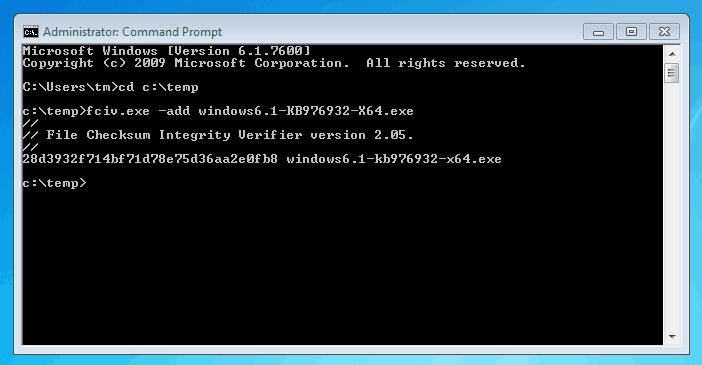
My FCIV screenshot:
http://geekswing.com/wp-content/uploads/2014/04/windows_md5sum_sha1_example.jpg
Great post OP
Hi,
After using Windows 8.1 for some weeks I thought about a GUI app to verify checksum, a Windows Store (Metro UI) app. So I developed a windows 8.1 app that allows file MD5/SHA hash generation, check and allow to compare two files hashes. The name is MD5 Win Verifier. You can try it at http://apps.microsoft.com/windows/en-us/app/md5-win-verifier/0c116c08-0bd6-42c4-80e3-476a7df6d934 .
I hope it could be usefull :)
cool!
But i have created a md5sum in linux using native utility, transfer files for FTP and when it arrive to windows 7 i need a utility for confirm if ftp was correct, i have tried with FCIV utilitybut it dosen’t work because in linux md5sum generate a plain file with some structure and FCIV use xml so it have different structures. How compare a md5 file generated in linux with another generated in windows for verify a ftp transfer?
@ivo ochoa: not only the five uses xml instead of a plain file, but the checksum is base64 encoded too into the xml… I think it is easy to code something that let you compare the five output with the md5sum one… Probably there is already something on the net that let you do that comparison…
Five = fciv :P
what is the fciv command to calculate a “physical” dvd checksum?
Actually you don’t need to install additional software.
Just use the Windows built-in certutil:
CertUtil -hashfile C:\TEMP\MyDataFile.img MD5
HashAlgorithm choices: MD2 MD4 MD5 SHA1 SHA256 SHA384 SHA512
thanks. So from you comment, we have to use an image file (img iso …), you can’t run a command straight on a CD/DVD as this linux command :md5sum /dev/scd0 ?
Thanks Sunder.. it works for me